


SEND and Targeted Support
If a child ever needs a little extra help along the way, we are here to work with our families to provide the best support for our children to succeed.
SEND: Targeted support
Every child learns differently, and many children will need a little extra help at some point during their school years. We have a system of support that allows us to identify difficulties at the earliest opportunity and begin to put targeted support to enable children to succeed.
SEND stands for Special Educational Needs and Disabilities. In simple terms, a child has a special educational need if they find it significantly harder to learn than most other children of their age, or if they have a disability that makes it difficult for them to use the everyday facilities in a school.
We group areas of need into four broad areas:
Children who need help talking, understanding language, or interacting with others (such as children with autism spectrum condition (ASC), speech delays, stammers or selective mutism).
Children who learn at a slower pace or have specific learning difficulties like dyslexia, dyscalculia or dyspraxia.
Children who experience difficulties managing their emotions, which might show up as high anxiety, low mood, or challenging behaviour (including conditions like ADHD).
Children who have physical medical conditions, visuals impairments, or hearing impairments that impact their ability to learn without adapted equipment.
Our partnership with our families

We know that our families know the children best. We view supporting children with SEND as a true partnership between home and school. We endeavour to listen to your insights, respect your wishes and work collaboratively at every stage of your child's educational journey.
How we support our pupils
We provide a graduated, tailored approach to support:
As part of our universal offer for all pupils, children have access to quality first teaching where all our teachers use inclusive adaptive strategies to support different learners. This may be in the form of flexible planning, adapted resources or adapted activities to match how different children learn.
When a child needs a little bit more focused support, we might offer small group work, specialised tools or targeted catch-up sessions.
Sometimes, we may need additional support from outside agencies to ensure that we are supporting the needs of pupils. We may need to work with representatives from the local authority, specialist teaching services, speech and language, Child / young person mental health services (CYPMHS) or SPOTSS.
If a child has complex needs that require a highly individualised plan, then they are likely to be supported by an Education Health Care Plan (EHCP). We work closely with external professionals to ensure highly dedicated, long-term specialist support for pupils.
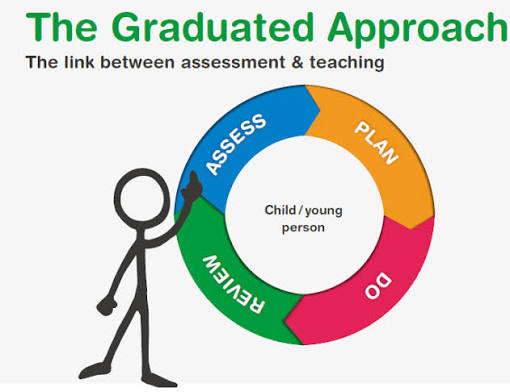 The Graduated Approach: Supporting Pupils
In our child centred approach, we use a continuous loop called the graduated approach.
Here are links to our policies to give you more information about ways we support children at Tarvin Primary School:
Meet Your SENDCO
My name is Mrs Sarah Cliffe, and I am the Special Educational Needs Coordinator (SENDCO) here at Tarvin Primary School. My role is to coordinate all the wonderful additional support our children receive and to act as a dedicated bridge between families, school and staff and external agencies. I also work as SENDCO across the other primary schools within The Sandstone Trust.
Whether your child has a formal diagnosis, or you have an initial concern please get in touch so we may discuss this further.
Phone: 01829 740399
Availability: By appointment via the main office or email.


